

You open the hospital bill after your wreck and see $40,000. It’s natural to assume that’s the number a jury will hear. In North Carolina, it often isn’t. Under Rule 414 of the North Carolina Rules of Evidence, the medical expenses you can present are usually the amounts actually paid to settle your bills, not the higher amounts printed on them.
This rule surprises many injured people, and insurance adjusters know it well. Here’s how Rule 414 works and what it means for your claim.
What Rule 414 Says
North Carolina adopted Rule 414 in 2011. It limits evidence of past medical expenses to two things:
- The amounts actually paid to satisfy bills that have been paid, “regardless of the source of payment”
- The amounts actually necessary to satisfy bills that are still outstanding
The rule also states that you have no duty to ask providers for discounts you aren’t contractually entitled to. North Carolina’s companion statute, N.C.G.S. § 8-58.1, lets you testify about the amounts paid or still owed, and creates a presumption that those amounts are reasonable.
Billed vs. Paid: Where the $40,000 Goes
Hospitals set list prices far above what most insurers actually pay. When your health insurer pays a bill, the hospital typically writes off the difference under its network contract. Here’s a hypothetical example:
| Line item | Amount | Counts under Rule 414? |
|---|---|---|
| Hospital’s billed charges | $40,000 | No, the full amount isn’t the measure |
| Contractual write-off by the hospital | −$28,000 | No, nobody paid it |
| Paid by your health insurer | $9,800 | Yes |
| Your deductible and coinsurance | $2,200 | Yes |
| Past medical expenses a jury may hear | $12,000 |
Because the rule counts payments regardless of their source, the money your health insurer paid still counts toward your claim. Having insurance doesn’t wipe out those expenses, but the contractual discount does lower the number.
How the Payer Changes the Number
Who pays your bills affects what the evidence will show:
| How your treatment was paid | What the evidence usually reflects |
|---|---|
| Private health insurance | The insurer’s negotiated payment plus your out-of-pocket share |
| Medicare or Medicaid | Government reimbursement rates, which are often well below billed charges |
| MedPay (auto medical payments coverage) | The amounts MedPay actually paid |
| Bills still unpaid | The amount actually necessary to satisfy the bill |
| Self-pay or cash discount | The discounted amount you paid |
What Rule 414 Doesn’t Limit
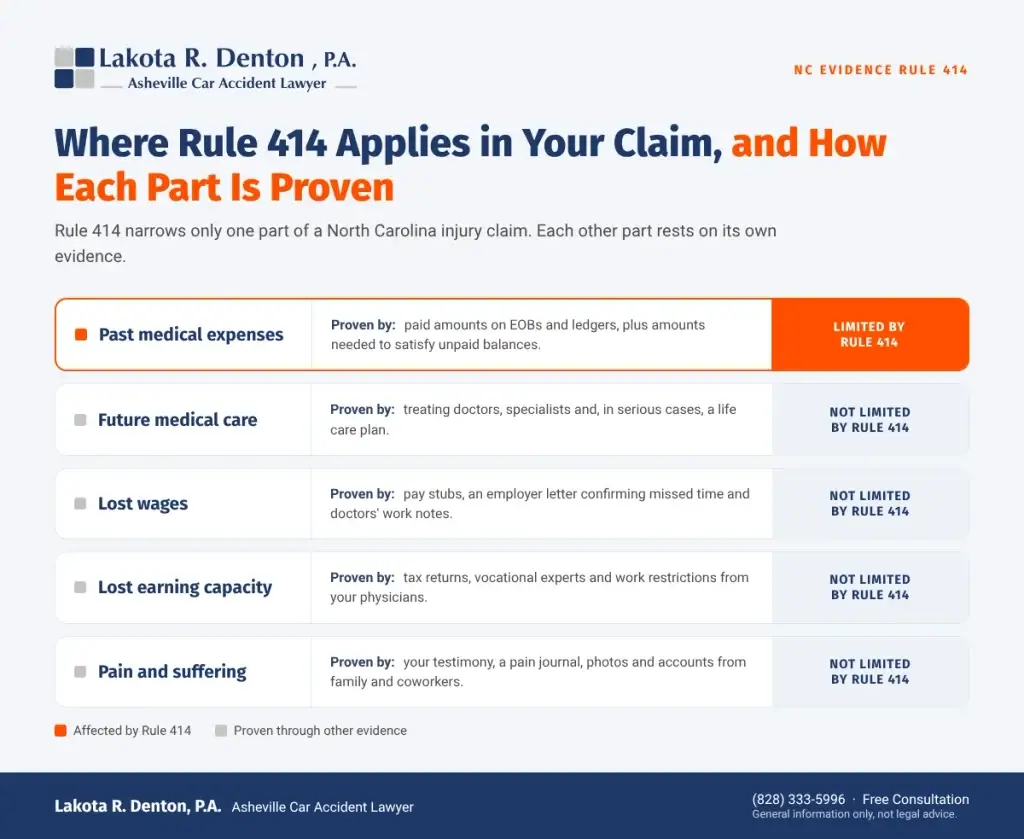
Rule 414 is narrower than many people think. Its text addresses past medical expenses only. Future medical care, such as surgery, therapy, or ongoing pain management, is proven through your doctors’ testimony about what that care will cost.
The rule also doesn’t touch the other parts of your damages: lost wages, reduced earning capacity, and compensation for pain and suffering. Those often make up most of the value of a serious injury claim. Our guide to maximizing your personal injury compensation covers how each of these categories is built.
![Chart showing Rule 414 limits only past medical expenses in a North Carolina injury claim]](https://asheville-car-accident-lawyer.com/wp-content/uploads/2026/10/lakota-rule-414-documents-checklist-1024x806.webp)
Why This Matters Before You Settle
Adjusters build their settlement offers around the numbers a jury would actually see. If you calculate your claim from billed charges, you may expect a figure the insurer will never pay, and you may misjudge a fair offer. An accurate picture requires itemized bills, explanation-of-benefits statements, and current account ledgers from every provider.
Medical providers can also claim a lien on your recovery for unpaid treatment. North Carolina caps those provider liens at 50% of the recovery after attorney’s fees under N.C.G.S. § 44-50. Health insurers and government programs have their own repayment rules, which is one more reason to understand your bills before you sign a release. If you’re still sorting out who pays what, our walkthrough of paying medical bills after a car accident in North Carolina is a good place to start.
Get Your Numbers Right with an Asheville Car Accident Lawyer

Rule 414 doesn’t have to shrink your case. It just means the case has to be built on accurate evidence from the start. Lakota R. Denton, P.A. gathers the payment records, works with your doctors on future care costs, and documents the full impact of your injuries.
If you were hurt in a wreck in Western North Carolina, talk with an experienced Asheville car accident lawyer about what your claim is really worth. Call (828) 333-5996 for a free consultation.
Frequently Asked Questions
Does Rule 414 apply if my case settles before trial?
Rule 414 is a rule of evidence, so it formally governs what a jury hears at trial. Because insurers value claims based on what could be proven in court, it still shapes settlement negotiations in nearly every North Carolina injury case.
Should I use my health insurance after a car accident in North Carolina?
In most cases, yes. Health insurance gets you treated promptly and protects you from collection actions while your claim is pending. Not using insurance doesn’t guarantee the full billed amount will count, because evidence is still tied to what is actually necessary to satisfy the bill. Talk with a lawyer about your situation before choosing to self-pay.
Will my health insurer want its money back from my settlement?
Often, yes. Many health plans, Medicare and Medicaid have rights to be reimbursed from an injury recovery. These claims can sometimes be negotiated down, which is an important part of maximizing what you take home.
Does Rule 414 apply in wrongful death cases?
Medical expenses claimed in a wrongful death case are past expenses, so the same limits on billed versus paid amounts generally apply. Other wrongful death damages, such as the loss of the person’s companionship and support, are not governed by Rule 414.
When did Rule 414 take effect?
The rule was added to the North Carolina Rules of Evidence by legislation passed in 2011.
Does Rule 414 lower the amount I can recover for pain and suffering?
Not directly. North Carolina doesn’t cap pain and suffering in most injury cases, and the rule only addresses past medical expenses. Some adjusters use medical costs as a rough starting point for valuing pain and suffering, so accurate documentation of your symptoms and recovery matters.