
North Carolina’s car accident laws, including our strict contributory negligence system and updated insurance requirements, are critical to understand if you are driving in Asheville or anywhere else in the state. When negligent, distracted, or impaired drivers violate these laws and cause harm, they have a legal responsibility to compensate you.
How you respond after a crash, whether it’s a minor fender bender on I-26 or a serious collision, can make the difference between securing the compensation you need or forfeiting your rights completely.
Here is what you need to know about North Carolina’s car accident laws in 2026 and how Asheville personal injury attorney Lakota Denton can help safeguard your rights.
2026 Insurance Requirements for North Carolina Motorists
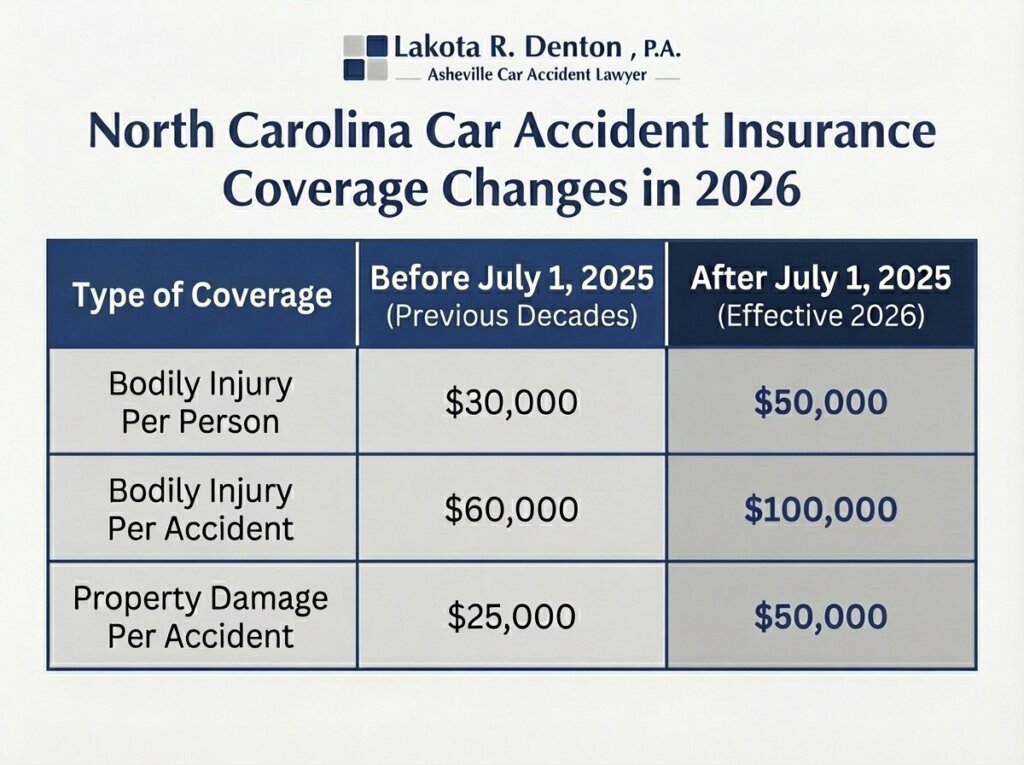
As of July 1, 2025, North Carolina implemented massive changes to its minimum auto liability requirements (under Senate Bill 452), making the insurance landscape for 2026 significantly different than in previous decades.
Every vehicle registered in North Carolina must be insured with a minimum liability coverage of 50/100/50. This breaks down to:
- $50,000 for bodily injury per person (previously $30,000)
- $100,000 for bodily injury per accident (previously $60,000)
- $50,000 for property damage per accident (previously $25,000)
Because North Carolina is not a no-fault state, an innocent driver’s insurance is not automatically required to pay for damages. Restitution falls on the at-fault driver’s insurer.
Changes to Uninsured/Underinsured Motorist (UM/UIM) Coverage
The new 2026 laws also revolutionized UM/UIM coverage. In the past, insurance companies could use a “liability setoff,” meaning they could reduce your UIM payout by whatever the at-fault driver’s insurance already paid. This offset has been eliminated. Now, if you are hit by an underinsured driver, you can collect the full limit from the at-fault driver’s liability coverage plus the full limit of your own UIM policy, maximizing your financial recovery.
If you’re involved in a crash with an inadequately insured driver, your attorney can walk you through the best options for leveraging these new stacking rules or filing a lawsuit directly against the at-fault driver.
Fault and Liability Laws
North Carolina follows strict at-fault accident laws, which means the person who caused the crash is financially liable for all damages.
However, North Carolina is also one of the few remaining states to use the doctrine of contributory negligence. Under this harsh law, if a victim is found to be even 1% at fault for the collision, they are completely barred from seeking compensation from the other driver. Insurance providers aggressively rely on this rule to deny valid claims.
Thorough evidence collection and investigation by an experienced Asheville car accident lawyer are essential to disproving any shared fault and securing your right to compensation.
Drunk and Impaired Driving Laws
It is illegal in North Carolina to drive a vehicle while visibly impaired or with a blood alcohol content (BAC) of 0.08% or higher.
While the state holds a drunk driver criminally responsible, victims must pursue a separate civil lawsuit for personal injury to recover compensation for the harm caused. Additionally, North Carolina’s “dram shop laws” allow individuals harmed by an impaired driver to hold establishments (like bars or restaurants) liable if they negligently served alcohol to a visibly intoxicated patron who then caused a crash.
Regulations for Fender Benders and Minor Crashes
North Carolina has a “fender bender law” that requires motorists involved in minor crashes with no serious injuries to move their vehicles out of the flow of traffic. Failing to move your vehicle to the shoulder can result in citations. More importantly, remaining in the roadway increases the risk of secondary crashes that drastically complicate liability claims.
Hit-and-Run Laws
Leaving the scene of a car accident is a crime in North Carolina, especially if the crash results in personal injuries or serious property damage. Hit-and-run accidents incur severe criminal penalties. On the civil side, a person harmed by a driver who flees the scene may be eligible to collect both compensatory and punitive damages.
If you are struck by a hit-and-run driver, whether in another vehicle, on a bicycle, or as a pedestrian, you should contact the police immediately. Even if the driver is never found, you may still be able to recover compensation through your own Uninsured Motorist (UM) coverage.
Distracted Driving Laws
North Carolina enforces hands-free regulations designed to curb the dangerous habit of distracted driving. The distracted driving laws are divided into specific categories:
- Drivers under the age of 18 are prohibited from all mobile device use while driving, except to contact a parent, guardian, or emergency services.
- Drivers over the age of 18 are prohibited from texting or emailing while the vehicle is in motion.
- School bus drivers must observe strict hands-free operation; violations can result in misdemeanor charges.
If you’ve been harmed by a driver who was texting or distracted, you have the right to pursue a civil lawsuit. Our legal team knows exactly how to subpoena cell phone records and collect evidence of negligent driving to support your claim.
Unique Accidents With Special Legal Considerations
Some car crashes involve complex legal rules depending on who is at fault. North Carolina’s car accident laws are highly nuanced in these specific scenarios:
Crashes With Teen Drivers
When a teenage driver causes a car accident, North Carolina laws often hold the driver’s parents or guardians financially responsible. Under the “Family Purpose Doctrine,” a vehicle owner can be held liable for damages caused by a family member using the vehicle with permission. This means you can pursue the parents’ auto insurance policy for your injuries.
Government-Related Accidents
A car accident involving a government entity, such as an Asheville city bus or a state-owned vehicle, falls under the North Carolina State Tort Claims Act. This law partially waives the state’s sovereign immunity, allowing injured parties to take legal action. However, claims against the government involve strict administrative procedures and significantly shorter statutes of limitations.
Multi-Vehicle Accidents
Crashes involving three or more vehicles create unique challenges in establishing fault across multiple parties and insurers. An experienced Asheville multi-vehicle accident lawyer can untangle overlapping liability questions and ensure every responsible party is held accountable.
Passengers Injured in a Crash
If you were riding in a vehicle when an accident occurred, you have distinct legal rights regardless of which driver was at fault. Learn more about your rights as an injured passenger in a car accident in North Carolina.
Understanding Your Insurance Claim
Navigating the insurance claims process after a crash is rarely straightforward. The at-fault driver’s insurer will look for every opportunity to minimize your payout, especially given North Carolina’s contributory negligence rule.
Our complete guide to insurance claims after North Carolina accidents walks you through exactly what to say, what to avoid, and how to protect your claim from day one.
Frequently Asked Questions About 2026 NC Car Accident Laws
Can my insurance company still reduce my UIM payout based on what the at-fault driver paid?
No. The new laws eliminated the liability offset, meaning you can now collect the full amount from the at-fault driver and the full limit of your own UIM policy.
What happens if I am found partially at fault for my car accident?
Because North Carolina is a contributory negligence state, being found even 1% at fault can completely prevent you from recovering any compensation from the other driver.
When am I legally required to report a car accident to the police in NC?
Under North Carolina law, you must report a motor vehicle accident to local law enforcement or the State Highway Patrol if the crash results in an injury, a fatality, or total property damage amounting to $1,000 or more.
Is Uninsured Motorist (UM) coverage mandatory in North Carolina?
Yes. State law requires all drivers to carry Uninsured Motorist (UM) coverage. As of the recent rate changes, this must match the state’s minimum liability limits: $50,000 per person for bodily injury, $100,000 per accident for bodily injury, and $50,000 for property damage.
Can an insurance company force me to use their preferred auto repair shop?
No. North Carolina law strictly prohibits “steering.” You have the legal right to choose the auto repair or body shop where your vehicle is fixed, and the insurance company must honor the estimate from your chosen shop, provided it is reasonable and customary for the market.
Are punitive damages available in North Carolina car accident cases?
Yes, but they are restricted. Punitive damages are not awarded for standard negligence. You must prove by “clear and convincing evidence” that the at-fault driver exhibited fraud, malice, or willful and wanton conduct (such as egregious drunk driving).
In North Carolina, punitive damages are capped at three times the amount of compensatory damages or $250,000, whichever is greater.
Schedule Your Free Case Consultation with North Carolina Car Accident Attorney Lakota Denton
When an at-fault driver ignores the rules of the road, they should be held fully accountable for your injuries, medical bills, and lost wages. If you have been injured in Western North Carolina and need help navigating these complex, updated laws, schedule your free consultation with Lakota Denton. It’s the next best step for securing the settlement you deserve.