
Under North Carolina law, a plaintiff in a car accident injury case cannot claim compensation if their negligence contributed, even to the smallest degree, to the resulting accident injuries. However, there is one exception to the strict application of contributory negligence, which is the Last Clear Chance Doctrine. Understanding this doctrine, its application, and its limitations is essential for accident victims seeking fair compensation for car accidents.
What Is the Last Clear Chance Doctrine?
The Last Clear Chance Doctrine is a legal principle in tort law that allows a plaintiff (the injured party) to recover damages even if they were partially negligent, as long as the defendant had the final opportunity to avoid the accident but failed to do so. This doctrine provides a pathway to recovery in situations where both parties may share some degree of fault.
Traditionally, North Carolina follows a strict contributory negligence system. Under strict contributory negligence, if a plaintiff is even 1% at fault for an accident, they may be barred from recovering any damages. This is a strict standard compared to comparative negligence states, where fault is apportioned. The Last Clear Chance Doctrine provides a potential exception to this strict rule, focusing on who had the final opportunity to prevent the accident.
What Are the Elements of the Last Clear Chance Doctrine?

For the Last Clear Chance Doctrine to apply, the following legal conditions must be met.
Plaintiff Negligence
The plaintiff must have been negligent in a way that contributed to the accident. For example, failing to stop at a traffic signal or speeding.
The Defendant’s Opportunity to Avoid the Accident
Despite the plaintiff’s negligence, the defendant must have had a clear opportunity to avoid causing the accident. This requires proving that the defendant could reasonably have acted differently to prevent the collision.
The Defendant Failed to Act
The defendant failed to take reasonable action to avoid the accident, such as slowing down, stopping, or changing lanes to prevent the collision.
The Failure to Act and Causation
The defendant’s failure to act was a direct cause of the injuries sustained by the plaintiff.
If these elements are met, the plaintiff may be able to recover damages, even if they were negligent.
How the Doctrine Works in North Carolina Car Accident Cases
North Carolina courts have recognized the Last Clear Chance Doctrine in cases where strict contributory negligence would otherwise prevent recovery.
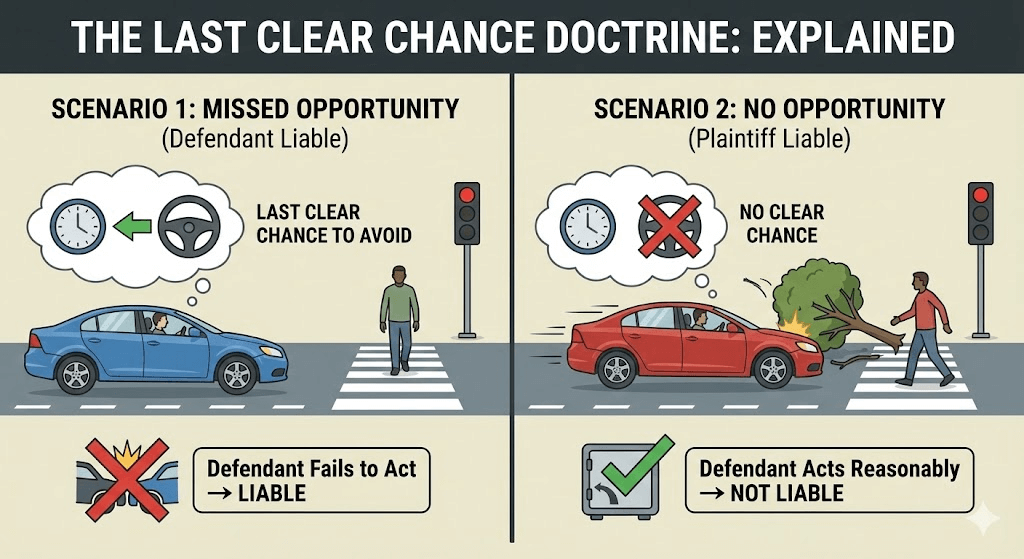
Last Clear Chance Doctrine Example
Imagine a pedestrian crosses the street improperly, failing to use a crosswalk. A driver sees the pedestrian and has ample time to stop or swerve safely, but does not take action, resulting in a collision. Even though the pedestrian was negligent, the driver’s failure to avoid the accident constitutes the “last clear chance,” allowing the pedestrian to recover damages.
This doctrine shifts the focus from solely who was negligent first to who had the final opportunity to prevent harm. It emphasizes responsibility for those who fail to exercise reasonable care when they could have prevented an accident.
The Most Common Last Clear Chance Cases
In North Carolina, courts generally recognize two main scenarios:
1. Helpless Plaintiff
The plaintiff is unable to avoid the accident due to some incapacity or dangerous situation. For example, a pedestrian who falls into the roadway or a driver whose brakes fail. The defendant can be held liable if they had the last clear chance to prevent harm.
2. Inattentive Defendant
The plaintiff was in a potentially dangerous position, but the defendant could have avoided the accident through reasonable care. This is the most common application in car accident cases, occurring when a negligent driver fails to act after noticing a hazard.
Understanding which type of case applies is crucial, as it affects how evidence is gathered and presented.
Evidence Needed to Prove a Last Clear Chance Case
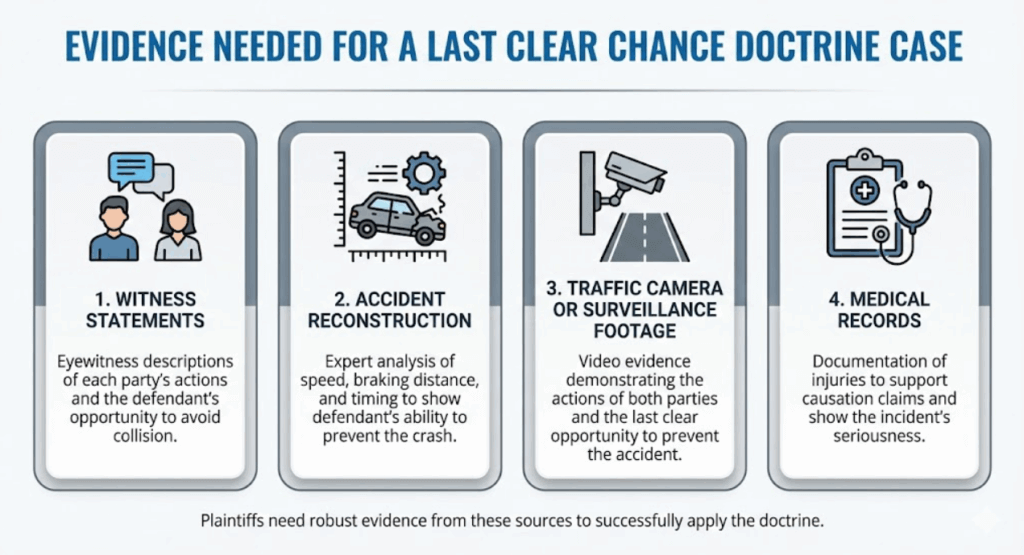
Successfully applying the Last Clear Chance Doctrine requires careful collection of evidence. Plaintiffs should consider the following:
- Witness Statements
Eyewitnesses can describe what each party did leading up to the accident and whether the defendant had an opportunity to avoid the collision.
- Accident Reconstruction
Experts can determine speed, braking distance, and timing to show that the defendant had the ability to prevent the crash.
- Traffic Camera or Surveillance Footage
Video evidence can clearly demonstrate the actions of both the plaintiff and defendant, showing the last clear opportunity to prevent the accident.
- Medical Records
Documentation of injuries can support claims of causation and show the seriousness of the incident.
Plaintiffs often need robust evidence to apply the last clear chance doctrine because of the aggressive application of contributory negligence through the courts.
Limitations of the Doctrine
While the Last Clear Chance Doctrine provides a potential lifeline for plaintiffs in contributory negligence states, it has limitations:
- Plaintiff’s Own Action
If the plaintiff’s negligence was so extreme that the defendant could not have reasonably avoided the accident, the doctrine may not apply.
- Timing and Opportunity
Courts require that the defendant truly had the “last clear chance.” If the opportunity to avoid the accident was fleeting or impossible, the doctrine is unlikely to succeed.
- Strict Application in the North Carolina Courts
North Carolina courts apply the doctrine cautiously, as contributory negligence rules still heavily favor defendants.
Understanding these limitations is essential for plaintiffs and their attorneys when building a case strategy.
How Can I Protect My Rights Under the Last Clear Chance Doctrine?
- Document Everything: Take photos of the scene, vehicles, skid marks, and any relevant road signage.
- Seek Medical Attention: Prompt treatment not only protects your health but also creates a record of injuries.
- Consult an Experienced Attorney: A skilled car accident lawyer can evaluate whether the Last Clear Chance Doctrine applies, gather evidence, and negotiate with insurance companies.
- Avoid Admitting Fault: Even minor statements can be used against you. Let your attorney handle communications with insurance providers.
Call Lakota Denton to Find Out Whether the Last Clear Chance Doctrine Applies in Your Case
The Last Clear Chance Doctrine is an important exception to North Carolina’s strict contributory negligence rules. It allows accident victims to recover damages even when they share some responsibility, as long as the defendant had the final opportunity to prevent the collision.
By understanding this legal principle, accident victims and their attorneys can evaluate potential claims, gather evidence, and pursue the compensation they deserve.
If you or a loved one has been injured in a car accident in North Carolina, it’s critical to seek legal guidance as soon as possible. An experienced attorney can determine whether the Last Clear Chance Doctrine applies in your case, protect your rights, and help navigate the state’s complex negligence laws.
Request your free consultation with Lakota Denton to discuss the potential application of the Last Clear Chance Doctrine in your injury case.