

After a North Carolina car accident, proving that another driver caused the crash is only part of the challenge. You must establish negligence with evidence showing how the driver’s conduct caused your collision and injuries. North Carolina adds another layer of difficulty, as the contributory negligence rule can bar recovery if the injured person is also found negligent.
What Is Negligence in a North Carolina Car Accident?
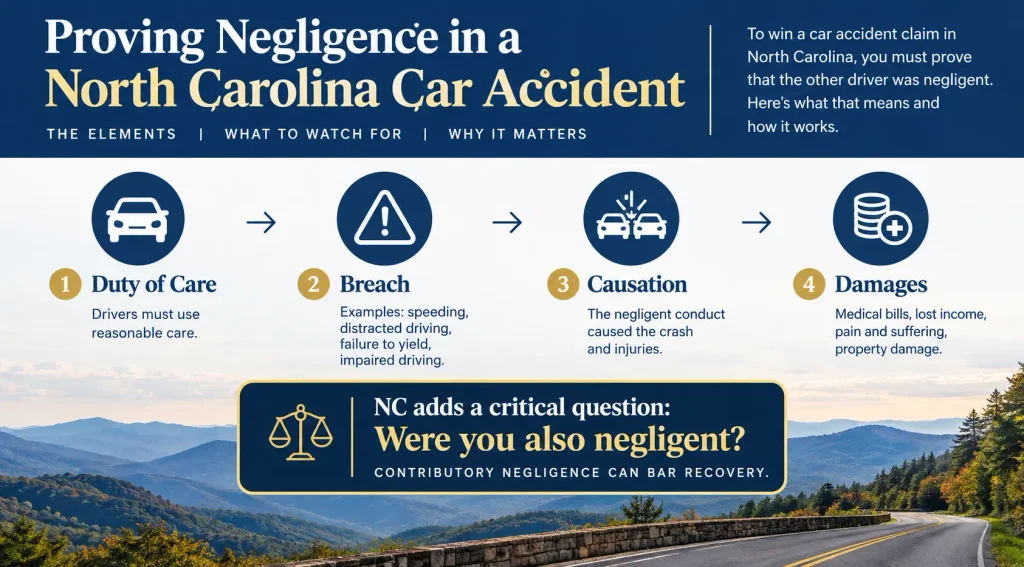
Negligence generally means failing to use the care a reasonably prudent person would use under similar circumstances. In a car accident case, the injured person must show that the other driver owed a duty of reasonable care, breached that duty, and that the breach proximately caused the injury. North Carolina courts describe proximate cause as a continuous causal connection and reasonable foreseeability.
| Element | What You Need to Establish | Examples of Evidence |
| Duty of care | The driver had a responsibility to operate safely | Traffic laws, ordinary driving standards |
| Breach | The driver failed to use reasonable care | Speeding, distraction, failure to yield |
| Causation | The breach caused the collision and injuries | Photos, witnesses, reconstruction |
| Damages | You suffered legally compensable harm | Medical records, bills, wage records |
1. Duty of Care
Drivers have a legal duty to operate their vehicles with reasonable care toward other people using the road.
2. Breach of Duty
The driver failed to meet that standard. Examples include speeding, following too closely, distracted driving, impaired driving, running a red light, or failing to yield.
3. Causation
The negligent conduct caused the collision and injuries. It is not enough to show that a driver behaved badly at some point; the evidence must connect the conduct to the crash.
4. Damages
The collision caused legally compensable harm, such as medical expenses, lost income, property damage, pain and suffering, or permanent impairment.
What Evidence Can Prove Negligence?
The strongest cases combine multiple pieces of evidence rather than relying on one document. A police report can identify contributing circumstances, but it is not necessarily the final word on liability.
Evidence may include:
- Photographs and video from the crash scene, vehicles, traffic signals, road conditions, and surrounding businesses.
- Eyewitness statements describing what happened immediately before impact.
- Dashcam, surveillance, traffic-camera, and cellphone evidence when available.
- Vehicle damage showing points of impact and supporting a reconstruction of the collision.
- Medical records connecting the injuries to the crash.
- Cellphone, electronic, or vehicle data that may help establish distracted or unsafe driving.
- Accident reconstruction or other expert testimony in complicated or serious cases.
Timing matters. Evidence can disappear, vehicles can be repaired, witnesses can forget details, and surveillance systems may overwrite recordings. A prompt investigation can therefore be critical. North Carolina law firms competing for this search term similarly emphasize immediate evidence preservation, witness accounts, police reports, and accident reconstruction.
Common Ways Drivers Are Found Negligent
Negligence does not require dramatic misconduct. A momentary failure to yield or an unsafe lane change can be enough if it causes a collision.
Common examples of negligent driving include:
- Speeding for conditions
- Texting or otherwise driving while distracted
- Driving under the influence
- Following too closely
- Failing to yield
- Running a stop sign or red light
- Making an unsafe turn
- Failing to maintain a proper lookout
In Asheville and Western North Carolina, the circumstances surrounding a collision can matter. Mountain grades, curves, changing weather, construction, tourist traffic, and busy interstates such as I-40 and I-26 can all become relevant to reconstructing what happened. The issue remains whether the driver exercised reasonable care under the circumstances.
Why Contributory Negligence Changes Everything in North Carolina
North Carolina is one of the few states that still follows strict contributory negligence. If an injured person contributed to the accident, even slightly, that negligence can bar recovery. North Carolina appellate decisions have repeatedly recognized the rule’s potentially complete bar to recovery.
For example, imagine another driver was speeding and crossed the center line, but the insurer argues you were also negligent because you were traveling too fast for conditions. In a comparative-negligence state, a court might assign percentages of fault and reduce your damages. In North Carolina, proving that you were not contributorily negligent can become a decisive issue.
North Carolina’s Pure Contributory Negligence Standard Vs. Other States
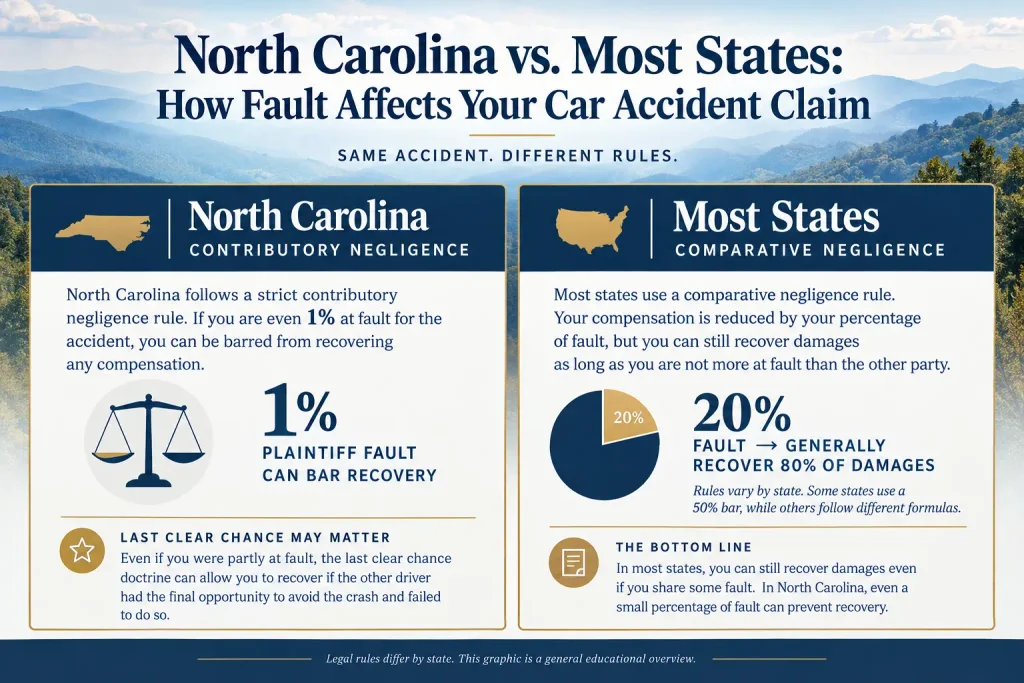
North Carolina is one of the few remaining jurisdictions in the United States that continues to apply the strict doctrine of pure contributory negligence. This doctrine is an affirmative defense against ordinary negligence claims, significantly raising the stakes in personal injury and premises liability litigation.
While most jurisdictions now use comparative fault models where financial damages are proportionally reduced based on the plaintiff’s share of the blame, North Carolina courts have consistently reaffirmed the traditional pure contributory negligence standard. Unless a plaintiff can prove the defendant acted with gross, willful, or wanton negligence, or establish that the defendant had the “last clear chance” to avoid the accident, even minor carelessness on the plaintiff’s part will result in a complete dismissal of the claim.
The rigidity and application of this rule have been continuously shaped and upheld by several landmark North Carolina Supreme Court decisions:
- Smith v. Fiber Controls Corp. (1980) – This foundational product liability and negligence case established the modern objective standard of behavior for plaintiffs in the state. The Supreme Court of North Carolina held that a plaintiff is contributorily negligent if they fail to discover and avoid a danger that a reasonably prudent person exercising ordinary care would have noticed. The ruling explicitly stated that a plaintiff’s failure to respect apparent risks operates as an absolute bar to recovery.
- Davis v. Hulsing Enterprises, LLC (2018) – In a more recent application, the state’s highest court affirmed the dismissal of a wrongful death and dram shop liability claim based entirely on the deceased’s contributory negligence. The Court reiterated the long-standing precedent that a plaintiff’s contributory negligence is a complete bar to recovery from a defendant who commits an act of ordinary negligence, emphasizing that when a complaint discloses contributory negligence on its face, the lawsuit must be dismissed.
- Draughon v. Evening Star Holiness Church of Dunn (2020) – Addressing premises liability, the Court ruled that individuals are expected to take reasonable steps to protect themselves from open and obvious risks. Because the plaintiff failed to exercise due regard for his own safety while navigating a visibly hazardous set of stairs, he was deemed contributorily negligent as a matter of law. The decision reaffirmed that ordinary negligence claims cannot survive if the plaintiff shares the blame.
What If You Were Partly at Fault?
Do not assume that an insurer’s accusation establishes contributory negligence. Fault should be tested against the evidence.
There is also a North Carolina doctrine known as last clear chance. In appropriate circumstances, an injured person who was contributorily negligent may still have a path to recovery if the other driver discovered, or should have discovered, the person’s peril in time to avoid the injury but failed to do so.
The doctrine is fact-specific and should not be treated as an automatic exception. North Carolina appellate decisions recognize last clear chance as a doctrine that can operate despite contributory negligence when its specific requirements are established.
Answers to Your Questions Regarding Car Accident Injuries Caused by Negligent Drivers
Can a police report prove negligence?
A police report can be important evidence, particularly when it records statements, observations, citations, or contributing circumstances. However, it is not necessarily conclusive. Other evidence may contradict or supplement the report.
What must I prove in a North Carolina car accident claim?
Generally, you must establish the other driver’s duty of reasonable care, breach of that duty, proximate causation, and damages. You may also need to defend against a claim that your own negligence contributed to the accident.
Can I recover if I was partly at fault?
North Carolina’s contributory negligence rule can bar recovery when the injured person is found negligent. There are limited doctrines, including last clear chance, that may affect the analysis.
How long do I have to file a North Carolina car accident lawsuit?
North Carolina generally provides a three-year limitations period for personal injury claims under N.C. Gen. Stat. § 1-52, although exceptions can apply. Do not wait to investigate a claim simply because the deadline appears distant.
Should I talk to the other driver’s insurance company?
You should be careful about giving statements or making admissions before you understand the evidence and your legal position. An insurer’s questions may focus on establishing a basis for disputing liability or alleging contributory negligence.
Call Lakota Denton to Explore Your Car Accident Litigation Options

- Car accident settlements include $1.25 million compensation claim
- National Top 100 Trial Lawyers Ranking
- Proven in Complex Negligence Claims Throughout North Carolina
If you were injured because another driver failed to use reasonable care, Lakota Denton can investigate the collision, identify the evidence supporting negligence, and fight attempts to place blame on you.
Contact Lakota Denton for a free consultation about your Asheville car accident claim.